
Does the opening decide whether they stay, and what to do with the first minute
Good news for live streamers: almost nobody sees your opening. Sounds bad. It's the opposite. Every minute of your stream is your opening, so you get a fresh shot at new people all night long.
The quick version
- Live: every minute is your opening. Make any random 30 seconds make sense, muted, under your title.
- Recorded video: everyone sees it. Cut straight to what the title promised.
- Short-form: a 20 second Short is mostly opening, so get motion and the promise into the very first second.
Live: every minute is your opening
Look at how people reach a stream, all of it documented by the platforms themselves. The browse card is "a frame from the last 5 minutes" (Kick's is "a frame from what is currently happening"). The Twitch mobile feed, which Twitch says is where over 70 percent of new-to-Twitch viewers start, autoplays muted and horizontal, with chat hidden until somebody taps. Raids drop everyone into the middle of a stream at once, possibly into a mid-roll ad. And follower notifications now default to Personalized. So even your followers are a shrinking slice of who gets told.
Twitch describes its own feed by saying the way to decide on a stream is "to actually see the stream". That's sampling. Nobody's watching an intro.
So ask yourself: what do 30 random seconds of my stream look like, muted, under my title? That's what the decision gets made on, and it gets made all night. Nothing in any official source suggests anybody besides a follower who was already waiting ever sees you open.
What to do on live
Keep your title saying what's happening right now, and keep your face or the action on screen. Talk like somebody just walked in, because somebody probably did. Greet people by name when they chat. None of that has been measured, and we're saying so, but it all follows from how people arrive.
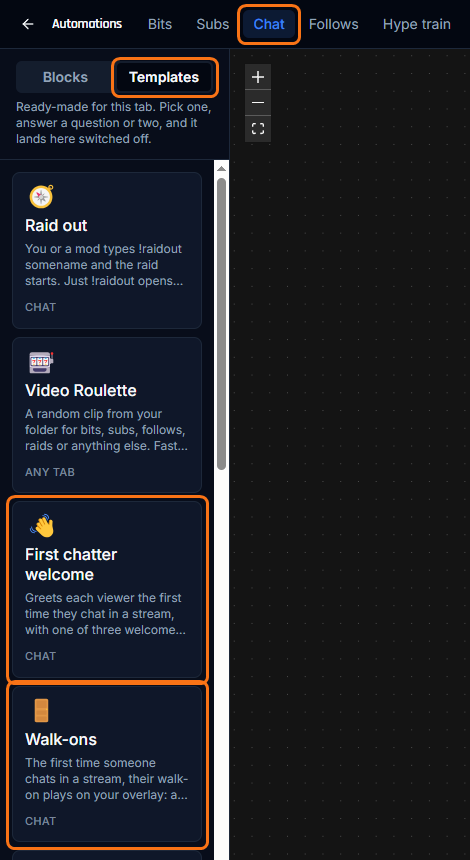
Twitch's one published number here: first-visit chatters are 50 percent more likely to return. That's correlation, and Twitch doesn't explain the method. Still, say hi. STB's First chatter welcome template greets each viewer's first message of the stream, and walk-ons play someone's own clip, GIF or sound the first time they chat, so nobody slips by unnoticed while you're mid-fight.
The Starting Soon screen is a real disagreement. Twitch's Creator Camp and two coaching blogs back 3 to 15 minutes of it, and Kick's help lists starting on a static screen as a mistake. Every source arguing for it assumes followers are gathering. If people find you through browse, they land on a countdown, so we come down on short-or-none. If you have a waiting audience, the other side is reasonable too.
Live has no retention graph (that's not your fault)
You can't measure this the way a YouTuber can. Twitch gives you concurrent viewers, totals, and one threshold: 5 minutes makes somebody an Engaged Viewer. Their 2022 promise of "audience retention data" never showed up. Kick has neither. YouTube Live is the exception and does report average view duration.
The only real measurement of how long people stay is a study from 2014: median visit 7.5 minutes, about 20 percent gone inside a minute, and most people who leave go to another live channel after about 7 minutes. The authors read that as viewers arriving without knowing what they want. It's old and it's big esports channels, so treat it as a rough shape for anyone smaller.
One more hint, and it's a negative result. Twitch built a Channel Switcher that showed a one-minute random preview, then rolled it back, saying it "wasn't effective in helping streamers grow their communities".
Recorded video: cut straight to the payoff
Every dataset shows the same early cliff, and none of them separates people who left because the opening was weak from people who clicked the wrong thing. A lot of it is mismatch, from five unrelated directions: YouTube's own intro tips put title and thumbnail first, a 2011 network study blamed early abandonment on interest mismatch, 2010 data found abandonment didn't change with clip length (it would if pacing drove it), and one research team found average watch percentage largely predictable from topic, length and channel before anybody clicked.
The fix with evidence behind it? Cut the setup. Wistia halved their initial loss by cutting a minute of intro to under ten seconds. Danny Deer, a solo game-dev creator, gained about 10 percent by removing his intro entirely. Blackman's small-channel graphs show three minutes of setup losing half the audience, with retention jumping the moment the real content starts. Each of those is one video or a snapshot. But nobody publishes the opposite, they all point the same way, and it costs nothing to try.
So open on what the title promised, say in one line why to keep watching, and cut the logo, the greeting and the channel explanation. (One counterexample worth knowing: a niche series with a ten-second title card held 80 percent at 30 seconds, because its audience was loyal. That's the returning-viewer effect below, and no argument for title cards.)
Check it in Studio: new against returning viewers
The clearest single number: Paddy Galloway split one video's retention and got 56 percent from subscribers against 37 percent from strangers. Same video, same opening, nineteen points from who showed up.
For a small channel, that means your early views are friends and subscribers, so your retention looks fine right up until a video reaches strangers. Split it by new versus returning in YouTube Studio (it's free). If subscribers stay and strangers bounce, it's your hook or how well the title matches, and the content isn't the problem.
Short-form: the first second
The platforms agree it's very early and disagree on the number.
| platform | what they say |
|---|---|
| TikTok | creator guidance says 5 seconds, their ads research says 3 |
| measures a 3 second skip rate, advises 5 | |
| YouTube | no figure published |
The famous "3 seconds" comes from TikTok's ads research and is about click-through on paid placements, which is a different thing from somebody scrolling their feed. TikTok's 2020 post names finishing a video as a strong signal. No platform names loops or rewatches, despite how often you're told they matter, and the "70 to 90 percent viewed" benchmark is one analyst's client data from large channels (he says not to obsess over it).
The part everyone agrees on costs nothing: open on motion and the promise.
Numbers you've been told that we couldn't stand up
"Aim for 70 or 80 percent retention" comes from a thumbnail tool's blog, and the real large-channel range vidIQ publishes is 38 to 68 percent at 30 seconds. The 38-to-56 percent case study is illustrative fiction presented as a real channel, and "55 percent gone in a minute" can't be checked anymore. "Quality CTR" and "seven seconds", attributed to Creator Insider, have no primary source anywhere. And re-hook schedules and pattern interrupts have no published test at all: the one channel whose internal document prescribes them says they need time and money, and that channel publicly reversed on fast pacing in March 2024.
Where this comes from
Platform mechanics come from Twitch's help, developer and blog pages, Kick's help, YouTube Live help, and TikTok's and Instagram's creator guidance. The measurement studies are cited in the sources. Twitch does publish its recommendation inputs on a legal page dated September 2025 (device, engagement, language, login state, region, watch history, age, with live channels prioritized more often), but no weighting and no channel-side factor.
Some parts are ours. "What do 30 random seconds look like, muted, under your title" is our synthesis of the documented mechanics, though Kick's help and StreamScheme's "you don't get to decide where they will start watching" come close. "A large share of the early drop is mismatch" is our reading of five sources that agree on the direction without quantifying it. Cutting the Starting Soon screen for a browse-found channel is inference from the browse mechanics plus Kick's guidance, and it runs against Twitch's own Creator Camp. "Talk as if someone just arrived" is consensus that follows from the mechanics, and nobody has measured it. The first-line-equals-stream-title idea is ours too. And treating the 2014 median as indicative today is an extrapolation from old data about big channels.
What we looked for and couldn't find
We found no controlled test of two different openings on the same video, no split of wrong-click loss from weak-opening loss, no official YouTube benchmark for intros or viewed-versus-swiped, and no official statement that the first seconds are weighted separately in ranking. TikTok and Instagram say nothing about loops or rewatches. Nobody has measured whether talking, silence or a Starting Soon screen changes how long live viewers stay, and Twitch publishes no per-viewer duration or new-viewer retention figure. No tracker publishes a benchmark for live session length (one sells a per-channel estimate, only above 3 average viewers). Nobody has studied how many channels somebody samples before settling on one, or how often the Twitch browse image refreshes beyond the 5 minute bound. Harris Heller and Alpha Gaming primary material was unreachable.
TL;DR: on live, make any 30 seconds make sense to a stranger, greet people by name, and keep Starting Soon short. On recorded video, cut to the payoff and check new against returning viewers. On short-form, motion in the first second.
How well supported this is
Several independent sources agreed
on recorded video the largest loss is in the first 30 to 60 seconds, on every platform and in every dataset (Finamore 2011, Visible Measures 2010, Wistia 2020, the MrBeast graph, vidIQ's channel, YouTube's and Instagram's own curve descriptions)
a large share of the early drop is arrivals who were never going to stay: YouTube lists title and thumbnail first among Intro fixes, Finamore attributes it to interest mismatch, abandonment did not vary with length in 2010, and the same video held 56 percent of subscribers but 37 percent of strangers
long setup before the first payoff loses viewers and cutting it helps, in small samples pointing the same way (Wistia before-and-after, Danny Deer, Blackman's graphs, YouTube's 2011 tip)
platforms say they weight watch time, completion and satisfaction, not the opening as such (YouTube 2012, Koval, TikTok 2020, Instagram's retention framing)
short-form decisions happen within the first few seconds (TikTok 5 seconds organic, Instagram 3-second skip metric and 5-second advice, analysts and creators one second)
on live, arrivals land mid-stream and the streamer does not choose the entry point (Twitch API thumbnail rule, Twitch feed help, Twitch raid help, Kick help, StreamScheme)
the browse-stage impression on live is a title plus a recent still or muted preview, never audio or an intro (Twitch API, Twitch feed help, Twitch July 2024 blog, Kick help)
talk continuously, greet by name, keep the title current, no static screen: consensus across Twitch Creator Camp, Kick help, StreamScheme, StreamerSquare, Hexeum, with no viewer measurement behind any of it
This rests on a single voice
the 7.5-minute median visit and one-in-five under a minute on live (one 2014 study of large esports channels)
first-visit chatters return 50 percent more often (Twitch Creator Camp, no method)
the 70 to 90 percent viewed-versus-swiped benchmark for Shorts (one analyst's client data)
cutting an intro lifted retention 10 percent on a small channel (one creator, one video)
the exact seconds figures: 15 (YouTube 2011), 5 (TikTok, Instagram), 3 (Instagram metric, TikTok ads), 1 (creators); only 'very early' is corroborated
the Channel Switcher rollback as evidence that one-minute sampling does not build communities (Twitch's statement, no data released)
Starting Soon screens: Twitch endorses, Kick discourages, nobody measured
Sources
official definition of the Intro key moment (share still watching after the first 30 seconds), the two suggested fixes (title and thumbnail match, or the first 30 seconds), 'videos on YouTube generally taper off'
What it misses: lists mismatch and opening as causes without saying which dominates; never says retention is a ranking input; key moments need 100 views so the smallest channels see nothing
the origin of the 15-second figure, a 2011 content tip: grab attention, make clear what the video is about, 'a flashy intro may look cool, but it's not the star'
What it misses: fifteen years old, no data, and now quoted as a rule it never was
watch time, not the intro, is the stated discovery signal (2012)
real numbers from one 2.39M-subscriber channel: 30.3 percent average viewed, 38 to 68 percent still watching at 30 seconds across six videos; the new-versus-returning diagnostic; the secondhand Matt Koval quote that retention is one way YouTube reads satisfaction
What it misses: one large channel; several tactics assume editing time; the 60-percent bar is their own
the same video held 56 percent of subscribers and 37 percent of strangers: the clearest illustration that the early drop is partly who arrived, not the opening
What it misses: one video, one creator
largest neutral YouTube measurement: most watched videos abandoned within the first 40 seconds, 60 percent watched for under a fifth of their length, attributed to interest mismatch
What it misses: 2011 YouTube, network-level, cannot see why anyone left
5.3 million videos: average watch percentage is largely predictable before publication from topic, length and channel (R squared 0.77) and stable over time, so the opening is working inside a ceiling set elsewhere
What it misses: says nothing about intros directly; 2016 data
23 million views: abandonment near zero for the first 2 seconds of startup delay, then 5.8 percent more per extra second; a slow or black-frame start behaves like a bad opening and is not one
What it misses: enterprise on-demand video, measures buffering not content
confirms the academic literature filters interest-driven abandonment out rather than measuring it, so the mismatch share is unquantified anywhere
2010 Visible Measures figures (20 percent gone by 10 seconds, 33 by 30, 44 by 60) and the finding that abandonment did not vary with clip length, an early sign the drop is about intent
What it misses: brand clips, pre-mobile, no method; still quoted as current
the immediate drop grows with length: 4.9 percent in the first 2 percent of a 1 to 2 minute video, 17.3 percent for 5 to 10 minutes
What it misses: business videos on web pages, and the 2 percent window is a different number of seconds at each length
the strongest before-and-after for cutting setup: trimming a minute of intro to under 10 seconds halved the initial loss and lifted engagement 5 points
What it misses: one video, a company with a video team, not YouTube
the only small solo creator before-and-after found: removing the intro entirely lifted retention about 10 percent on one video
What it misses: one video, base not stated, author's own caveat
small-channel graphs: three minutes of setup before the first point lost over half the audience; retention spiked the moment the content began; a hook that restates the title is a false start
What it misses: snapshots, no before-and-after
the counterexample: a niche series with a 10-second title card held 80 percent at 30 seconds because the audience was loyal, so a slow opening is fine when people already want you
'the first minute has the most loss' with one real graph (60M clicks, 39M at one minute) and the cheap transferable parts: match the thumbnail, plan the first line
What it misses: the most resourced channel on the platform; re-engagement spectacles 'need lots of time and money'; numbers do not transfer
the March 2024 reversal on fast pacing: cuts per minute down from 38 to 23, 'let scenes breathe', 'the ultra fast paced/overstim era ... doesn't even work'
What it misses: one channel's views cannot be attributed to pacing alone
Shorts product lead: 'the audience is the algorithm'; a view was meant to encode intent to watch; no swipe threshold given
the 'one second to hook someone' line is a creator's (Jenny Hoyos), not YouTube's; YouTube gives no seconds figure
the viewed versus swiped away metric definition; no benchmark and no loop guidance from YouTube
the only data behind the '70 percent viewed versus swiped is good' benchmark: 5,400 Shorts, best performers 70 to 90 percent, under 60 rarely did well, with the author's own 'don't obsess'
What it misses: large client channels, correlational, pre-2025 view counting
the loop and micro-loop advice in its current form, and a refusal to give a single benchmark
What it misses: evidence is 'what we see working', proprietary and unquantified; vendor
go-live notifications carry a custom message, so a notification arrival comes with context the streamer wrote
TikTok's organic guidance: hook 'ideally within the first 5 seconds'; phone footage is fine; about 30 percent watch muted
What it misses: no evidence for the 5 seconds; survey unsourced
finishing a video is named as a strong ranking signal; the first seconds and rewatches are not mentioned (2020)
the real origin of 'TikTok says 3 seconds': 63 percent of top click-through ads show the key message within 3 seconds
What it misses: paid ads and click-through, not organic completion; no sample or method
Instagram's August 2025 retention chart and 3-second skip rate, and its own advice to hook within 5 seconds; 'you'll always see a downward slope'
What it misses: official text quoted secondhand
the browse card image is 'a frame from the last 5 minutes of the stream', so a browse arrival sees a recent still and a title, never an opening
the mobile feed is a scrollable, muted-by-default live preview; chat only appears after a tap
'over 70% of our new viewers coming to Twitch first via the mobile app'; Twitch's design statement that the way to decide on a stream is to see it
What it misses: new to Twitch, not new to your channel; no method
every Twitch discovery surface in Twitch's words: curated carousel, personalised shelves, browse sorted by recommendation or viewer count, search with live first
What it misses: its carousel description (curated only, 'not populated through an automated system') conflicts with the legal Recommendations page, which says curated and programmatic; the legal page carries a date, this article does not
Twitch's published list of recommendation inputs for every surface (device, engagement, language, login state, region, watch history, age) and the statement that live channels are more frequently given higher priority; dated 09/22/2025
What it misses: publishes the inputs only; no weighting and no channel-side factor (viewer count, retention, chat) is documented anywhere
what Twitch reports (average viewers, minutes watched, unique viewers, raid viewers, estimated browse position by 30-day average) and therefore what it does not: any per-viewer duration
the only duration threshold Twitch publishes: an Engaged Viewer has watched at least 5 minutes; the arrival-source breakdown a streamer can see for their own channel
What it misses: new and returning panel is an experiment for a limited number of streamers
raid mechanics: everyone in chat is sent at once, announced in chat, no pre-roll, possible mid-roll, opt-out before it starts; Twitch's own etiquette and its admission 'with a bit of luck, the raiders will stick around'
Twitch's one first-visit number: chatters on their first visit are 50 percent more likely to come back; greet by name
What it misses: no method, and correlational: people who chat were already inclined to stay
Twitch endorses a Starting Soon scene as 'a place to gather' and warns against clutter and frozen frames
What it misses: presumes viewers who were waiting; never considers the browse arrival who lands on the countdown
follower notifications now default to Personalized, so whether a follower is told you are live depends on their past behaviour; a notification arrival is a shrinking subset
the plainest official statement of the live reframe: the browse preview is 'a frame from what is currently happening', 'starting a stream on a static screen' is a listed mistake, get into content quickly, update the title mid-stream
What it misses: 'decision in seconds' and 'perform better' are asserted without data
Kick raid mechanics and etiquette; a channel under 5 viewers cannot raid out; 'some of them may stay'
YouTube Live reports average view duration per stream, the only live per-view duration any of the three platforms gives
DVR lets a YouTube Live viewer rewind, the one live surface where a late arrival could see an opening
the only measured live dwell data: 136 large Twitch channels, 1.46M logged-in viewers, 139 days; median visit to a live channel 7.5 minutes, about 20 percent under a minute, 72 percent of switches live-to-live, viewers 'without knowing a priori the content they want to consume'
What it misses: 2013 to 2014, one esports game, big channels, chat-connection events rather than playback
15.5M Twitch users over 43 days: repeat consumption of specific channels is a dominant pattern, so most watching is of streamers already known
What it misses: the share is not quantified in the material that could be read; 10-minute snapshots cannot see short visits
Twitch built a one-minute ad-free random-channel sampler in 2022 and rolled it back in August 2025 saying it 'wasn't effective in helping streamers grow their communities'
What it misses: Twitch gave no data for the rollback
one raid case: 23 to 1,816 viewers, most gone 'within minutes', settled at about 60
What it misses: single extreme case, no decay curve, no follow conversion
'you don't get to decide where they will start watching'; a poll of 186 streamers naming silence as the top beginner mistake
What it misses: the poll measures what streamers believe, not what viewers do
the no-mods version of greeting by name: keep the viewer list open yourself; unacknowledged arrivals stay '3-5 minutes (sometimes even less)'
What it misses: anecdote from a 2013-era Partner; the viewer list misses anonymous and mobile arrivals
the pro-Starting-Soon position, 3 to 10 minutes, so the disagreement is recorded
What it misses: assumes followers to notify and gather; never addresses the browse arrival
the only in-ecosystem counterpoint that silence is sometimes fine and can build suspense
What it misses: its '10 seconds' figure is borrowed from digital marketing, not stream data
We also read and rejected 8 sources for this article, mostly for unsourced figures or for selling the thing they were assessing.
What we changed
followers with notifications on are told when you go live, so a go-live push reaches most of your followers
follower notifications default to Personalized, which decides per follower from past behaviour whether and where to notify; a notification arrival is a smaller, self-selected subset
Twitch renamed and redefined the default notification setting on 11 December 2025
Reels insights showed a view rate (share watched past 3 seconds) and no curve
Reels show a retention chart and a 3-second skip rate, and Instagram's own advice is a hook within 5 seconds
Instagram announced the metrics in late August 2025; the article date is used as the change date because the announcement posts themselves were not fetchable
a Shorts view meant the viewer passed a meaningful watch threshold, so view counts themselves said something about the opening
any Short that starts playing counts as a view; viewed versus swiped away is the only remaining intro signal in Studio
YouTube changed Shorts view counting on 31 March 2025 as reported by vidIQ; the exact day comes from that report
fast cuts, high energy and constant pattern interrupts are the template for holding retention
the channel that set that template slowed its pacing, let scenes breathe and said the overstimulated style 'doesn't even work'; keep the cut-to-the-payoff opening, drop the constant-stimulus rule
public reversal by the creator whose earlier style small channels copied; the tweet is dated 3 March 2024
Want this while you stream?
A.N.N.A is the SuperTurkBot assistant. She reads everything on this page and answers questions in your own dashboard, about your own channel, with your numbers in front of her. See SuperTurkBot.